To paraphrase the poet William Blake, you can see the world in a grain of sand. Similarly, you can learn a great deal about all asanas by carefully studying one. For this blog post, I focus on Hanumasana, or front splits. I use this pose in workshops to illustrate such factors as pose analysis, agonist/antagonist muscle pairs (and their synergists), physiological reflex arcs, and stretching biomechanics.
First, let’s look at the muscle-tendon unit—the muscle and its tendon—to see what lengthens in the pose. The muscle-tendon (MTU) unit is composed of several elements. These include the contractile structures (sarcomeres) and the fascial elements that surround the muscle fibers and tendons. Although these elements are often presented separately in articles on the science of stretching, in reality they are inextricably linked to one another. All of these elements contribute to muscle contraction and stretching. In addition, many factors contribute to the way a muscle lengthens, including the viscoelastic properties, creep (a type of deformation that has been postulated for fascial elements), psychological factors (such as muscle memory and tolerance), and extramuscular links to synergists. Individual muscle architecture or shape also plays a role. Below, I include several references from the scientific literature that discuss these factors in greater detail.
 |
| Cross-section of muscle illustrating the contractile sarcomeres with fascial elements such as the perimysium |
Next, there is the timing of the stretch or how long to hold it. I derive my personal approach to timing the stretch in Hanumanasana from published biomechanical studies on stretching. These studies indicate that the majority of lengthening or release of the MTU takes place in the first twenty seconds of the stretch. Similarly, when repeating a stretch, the lengthening of the muscle-tendon unit appears to diminish with each successive stretch, reaching its maximum at the fourth stretch, after which little additional length is gained by further stretching. We provide an illustrative curve for this process below. You can see the experimental curves in the referenced articles 1,2. Note that each successive lengthening of the muscle is followed by a brief recovery period in which it is released from the stretch. This is important because one two-minute stretch is not equivalent to four thirty-second stretches. Accordingly, I divide my approach to Hanumanasana into four consecutive stretches—each focusing on a different muscle group. Obviously, this is only one of the many ways to approach stretching. It is, however, a method I have found beneficial for working on specific poses such as front splits.
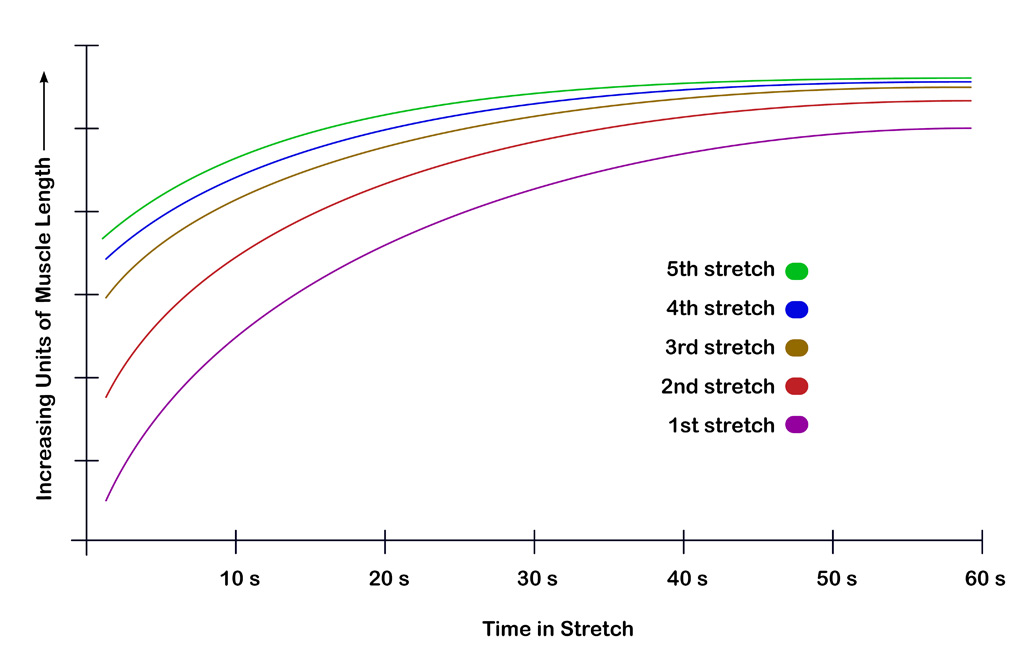 |
| Illustrative curves for changes in muscle length vs time in a stretch |
To begin, I analyze the positions of the major joints in Hanumanasana. For example, the back hip is extending. This means that the agonist muscles for this part of the pose are the gluteus maximus (the prime mover of hip extension) and the synergists of this action—the posterior portion of the gluteus medius and minimus, the hamstrings and the adductor magnus. Next, I use this analysis to determine which muscles are stretching. Extending the hip lengthens the hip flexors, including the psoas and its synergists. Then I apply physiological reflex arcs, including proprioceptive neuromuscular facilitation (PNF)3,4,5 to gain length in the muscles during successive thirty-second stretches. This is the first part of the Bandha Yoga Codex, a systematic approach that can be applied to any asana. Feel free to browse through the Yoga Mat Companion Series to see this concept in action.
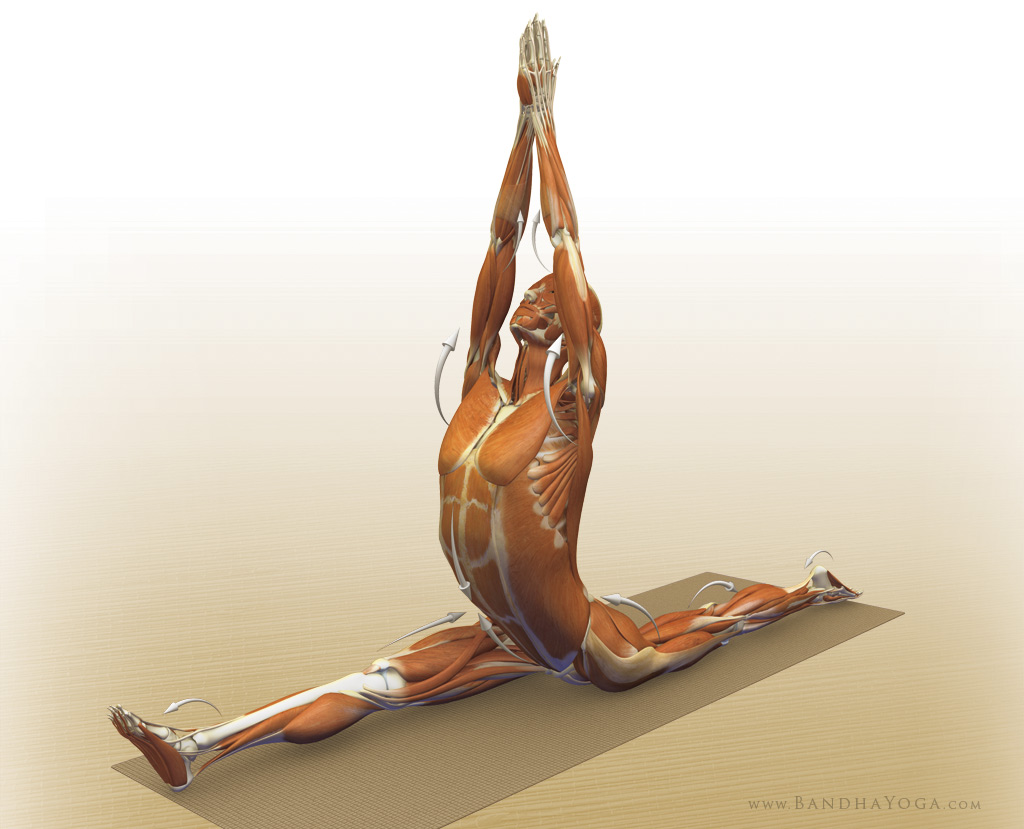 |
| Hanumanasana (front splits) illustrating the positions of the major joints |
For step one, I focus the stretch on the prime mover of hip flexion—the psoas—for the extended back hip. This stretch also works the rectus femoris. I use two sturdy chairs for support and begin by taking the muscle out to length by engaging the back leg gluteus maximus, producing reciprocal inhibition of the psoas and aiding it to relax into the stretch. Then I attempt to draw the back knee towards the front foot in a flexing type action, using just enough force to gently engage the psoas. I hold this for several breaths and then ease deeper into the stretch by again engaging the gluteus maximus, and limit the stretch to thirty seconds. Then I come out of the pose and stand in Tadasana to provide a brief recovery.
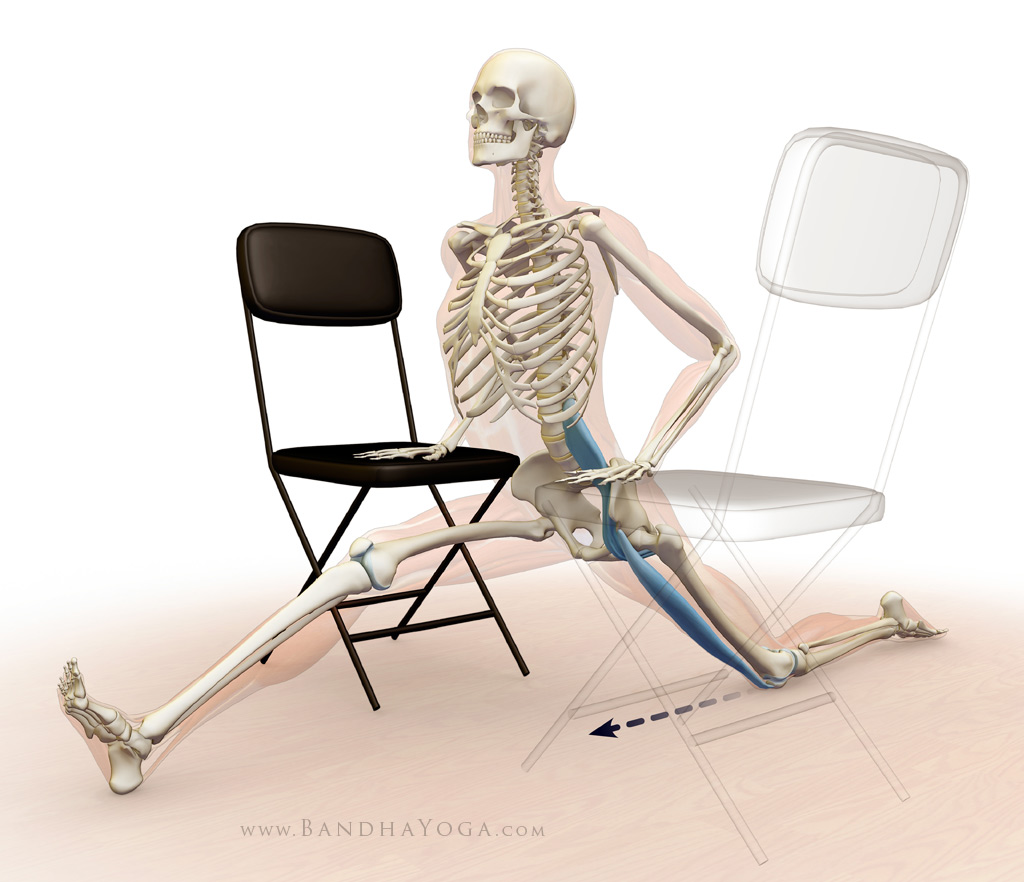 |
| Cue for engaging the back leg psoas and rectus femoris to use PNF for muscle lengthening |
For step two, I focus the stretch on the prime movers of hip extension for the flexed front hip. I begin by engaging the flexors of the front hip, including the psoas. I also engage the quadriceps. These muscles provide reciprocal inhibition of the gluteus maximus and hamstrings. One head of the quadriceps, the rectus femoris, also synergizes hip flexion. Then I slightly bend the knee and gently press the heel into a towel or blanket to engage the hamstrings and gluteus maximus of the front hip. I hold this action for a few breaths and then take the hamstrings and gluteus maximus out to length by engaging the hip flexors and knee extensors, again holding the total time in the stretch for a maximum of thirty seconds. Once again, I stand in Tadasana for a brief recovery (usually for about twenty seconds).
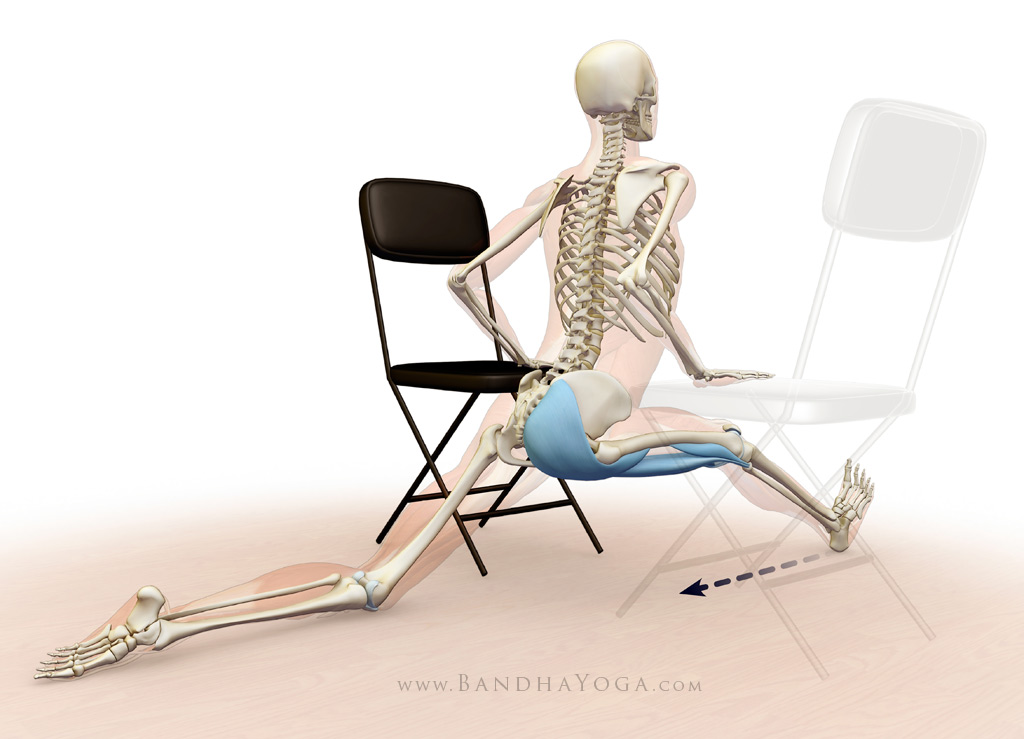 |
| Cue for engaging the front leg gluteus maximus and hamstrings to use PNF for muscle lengthening |
For step three, I stretch the synergists of hip flexion and extension that are located more medially. For the front hip, my focus is the adductor magnus (a synergist of hip extension that is stretching). For the back hip, I focus on the adductors longus and brevis, and the pectineus (synergists of hip flexion that are stretching). I slowly build engagement of these muscles respectively by attempting to draw the front heel and back knee towards the midline (adduction), again holding for a few breaths, then deepening the pose by relaxing more fully and engaging the back leg buttocks and front leg psoas and quads. I again use Tadasana for a brief recovery.
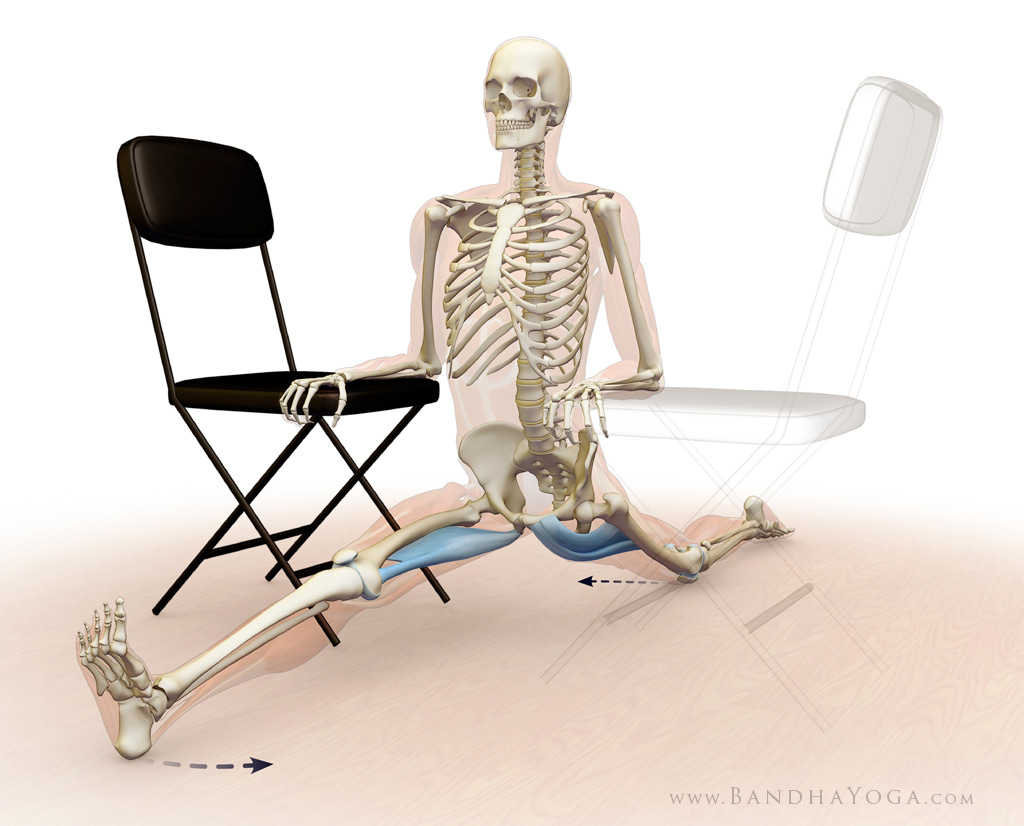 |
| Cue for engaging the adductor magnus (front leg) and adductors longus and brevis and pectineus for PNF |
Finally, I focus on stretching the synergists of hip flexion and extension that are located laterally or on the outside of the hips (for the back and front leg respectively). For the front hip, the synergist of extension includes the posterior part of the gluteus medius and gluteus minimus. Since both of these muscles are prime movers of hip abduction, I use this for my cue to engage them by attempting to drag the front heel away from the midline. At the same time, I engage the back hip tensor fascia lata by gently attempting to drag the knee away from the midline in the stretch. I hold this action for a few breaths and then ease deeper into the pose once again by engaging the back leg gluteus maximus and front leg psoas (and quads)—all for thirty seconds followed by a relaxed Tadasana. This is the fourth and final stretch of the series.
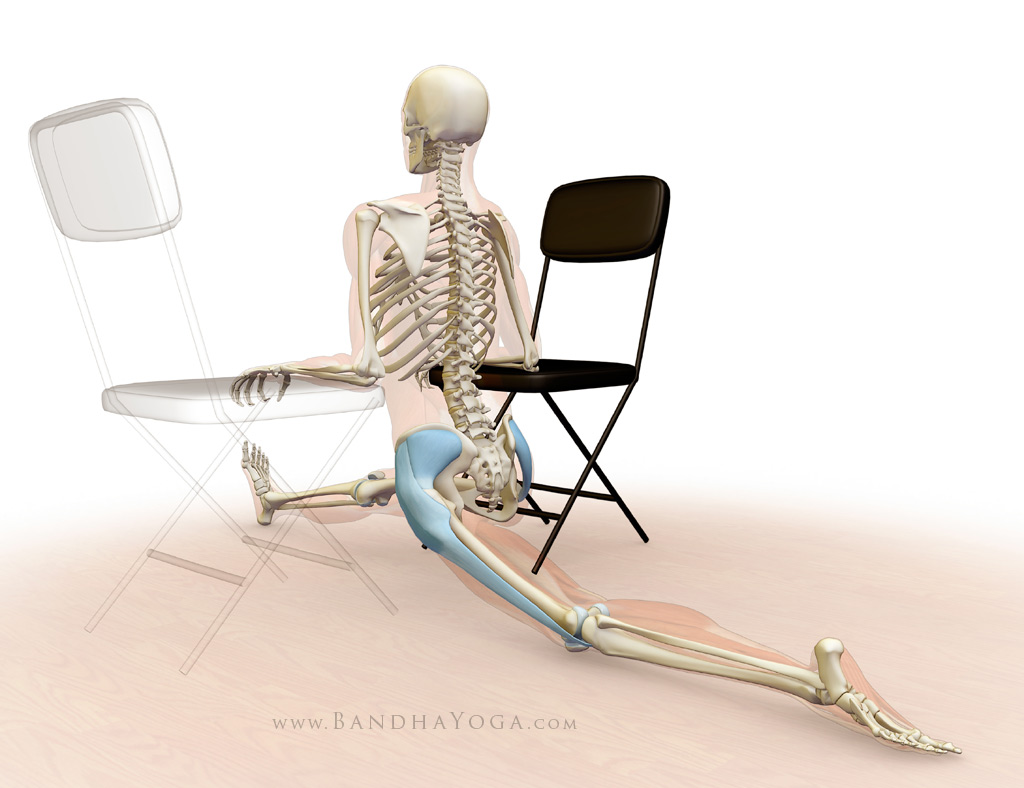 | 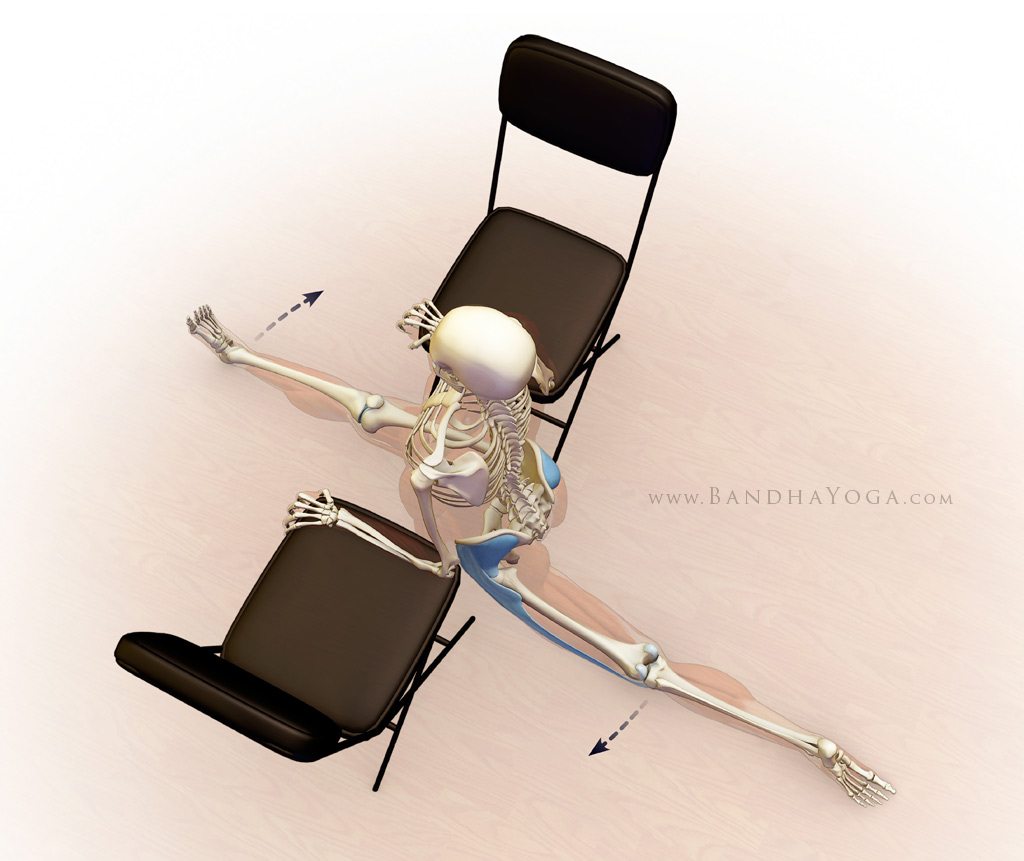 |
| Cue for engaging the abductor muscles of the front and back legs for PNF | |
For a balanced stretch, I repeat the series on the other side. I allow a 48-hour recovery period after applying PNF stretches. I never force myself into the pose, but rather use physiological reflex arcs to gently lengthen the muscles. I also use visualization and sensation of the muscles I’m stretching to focus my drishti for a safer and more effective practice. I slow my movements as I near the endpoint of the stretch and come out of the pose carefully. This aids to prevent injury.
We hope you enjoy this blog post and invite you to join us in paradise at Blue Spirit in Costa Rica this winter for our workshop on combining Western science and Hatha yoga. We will be going over essential principles of injury prevention for each of the major joints and many other subjects in this intense, yet fun workshop.
Remember that not all poses are suitable for all practitioners. Always practice under the direct guidance of a qualified instructor; use their assistance to determine modifications or suitability of a given pose for your individual practice. Always consult your healthcare provider and obtain medical clearance before practicing yoga or any other exercise program (read our disclaimer here).
Great to see you again. Check back for our next blog post when we will discuss another protective strategy to aid in preventing lower back strains in yoga and be sure to "like" us on Facebook and download your copy of our free E-book.
Namaste'
Ray and Chris
2) Taylor DC, Dalton JD Jr, Seaber AV, Garrett WE Jr. “Viscoelastic properties of muscle-tendon units. The biomechanical effects of stretching.” American Journal of Sports Medicine. May-Jun 1990;18(3):300-9.
3) Rees SS, Murphy AJ, Watsford ML, McLachlan KA, Coutts AJ. “Effects of proprioceptive neuromuscular facilitation stretching on stiffness and force-producing characteristics of the ankle in active women.” Journal of Strength and Conditioning Research. May 2007;21(2):572-7.
4) Higgs F, Winter SL. “The effect of a four-week proprioceptive neuromuscular facilitation stretching program on isokinetic torque production.” Journal of Strength and Conditioning Research. August 2009;23(5):1442-7.
5) Mahieu NN, Cools A, De Wilde B, Boon M, Witvrouw E. “Effect of proprioceptive neuromuscular facilitation stretching on the plantar flexor muscle-tendon tissue properties.” Scandanavian Journal of Medicine and Science in Sports. Aug2009; 19(4):553-60. Epub 2008 Jun 17.
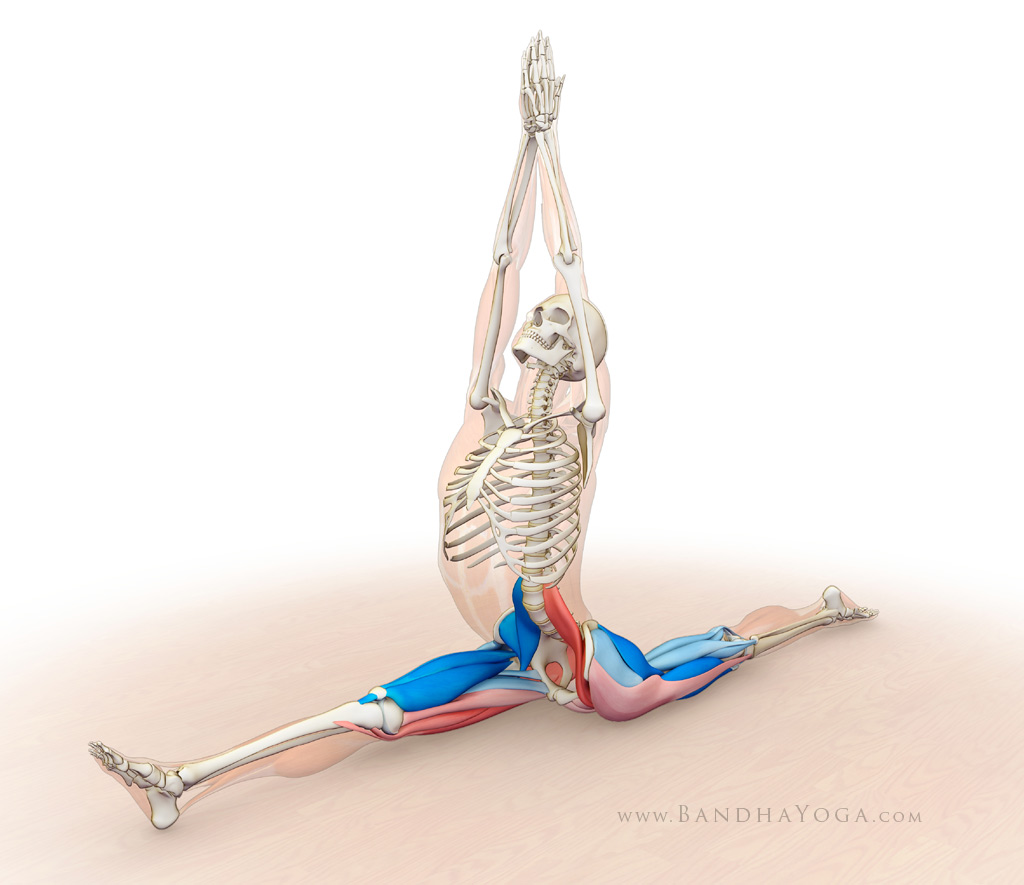 |
| Agonist (blue) and antagonist (red) muscles of the hips in Hanumanasana |
We hope you enjoy this blog post and invite you to join us in paradise at Blue Spirit in Costa Rica this winter for our workshop on combining Western science and Hatha yoga. We will be going over essential principles of injury prevention for each of the major joints and many other subjects in this intense, yet fun workshop.
Remember that not all poses are suitable for all practitioners. Always practice under the direct guidance of a qualified instructor; use their assistance to determine modifications or suitability of a given pose for your individual practice. Always consult your healthcare provider and obtain medical clearance before practicing yoga or any other exercise program (read our disclaimer here).
Great to see you again. Check back for our next blog post when we will discuss another protective strategy to aid in preventing lower back strains in yoga and be sure to "like" us on Facebook and download your copy of our free E-book.
Namaste'
Ray and Chris
1) Kato E, Vieillevoye S, Balestra C, Guissard N, Duchateau J. “Acute effect of muscle stretching on the steadiness of sustained submaximal contractions of the plantar flexor muscles.” Journal of Applied Physiology. Feb 2011;110(2):407-15. Epub 2010 Dec 2.
2) Taylor DC, Dalton JD Jr, Seaber AV, Garrett WE Jr. “Viscoelastic properties of muscle-tendon units. The biomechanical effects of stretching.” American Journal of Sports Medicine. May-Jun 1990;18(3):300-9.
3) Rees SS, Murphy AJ, Watsford ML, McLachlan KA, Coutts AJ. “Effects of proprioceptive neuromuscular facilitation stretching on stiffness and force-producing characteristics of the ankle in active women.” Journal of Strength and Conditioning Research. May 2007;21(2):572-7.
4) Higgs F, Winter SL. “The effect of a four-week proprioceptive neuromuscular facilitation stretching program on isokinetic torque production.” Journal of Strength and Conditioning Research. August 2009;23(5):1442-7.
5) Mahieu NN, Cools A, De Wilde B, Boon M, Witvrouw E. “Effect of proprioceptive neuromuscular facilitation stretching on the plantar flexor muscle-tendon tissue properties.” Scandanavian Journal of Medicine and Science in Sports. Aug2009; 19(4):553-60. Epub 2008 Jun 17.